
The Question of Reality - Consciousness and the Observer Effect
1. Donahue, William. "550 A New You Part 1." Lecture. *Hidden Meanings*, 2011.
What is reality? This ancient philosophical query has gained new urgency with the advent of quantum physics, particularly the discovery of the "observer effect." This phenomenon demonstrates that the act of observation fundamentally alters the behavior of subatomic particles, suggesting that consciousness may play a critical role in defining reality itself. The work of thinkers like William Donahue challenges our classical assumptions about the strict separation between mind and world, subject and object, inviting us to view consciousness not as a passive recipient of reality but as an active participant in its formation.
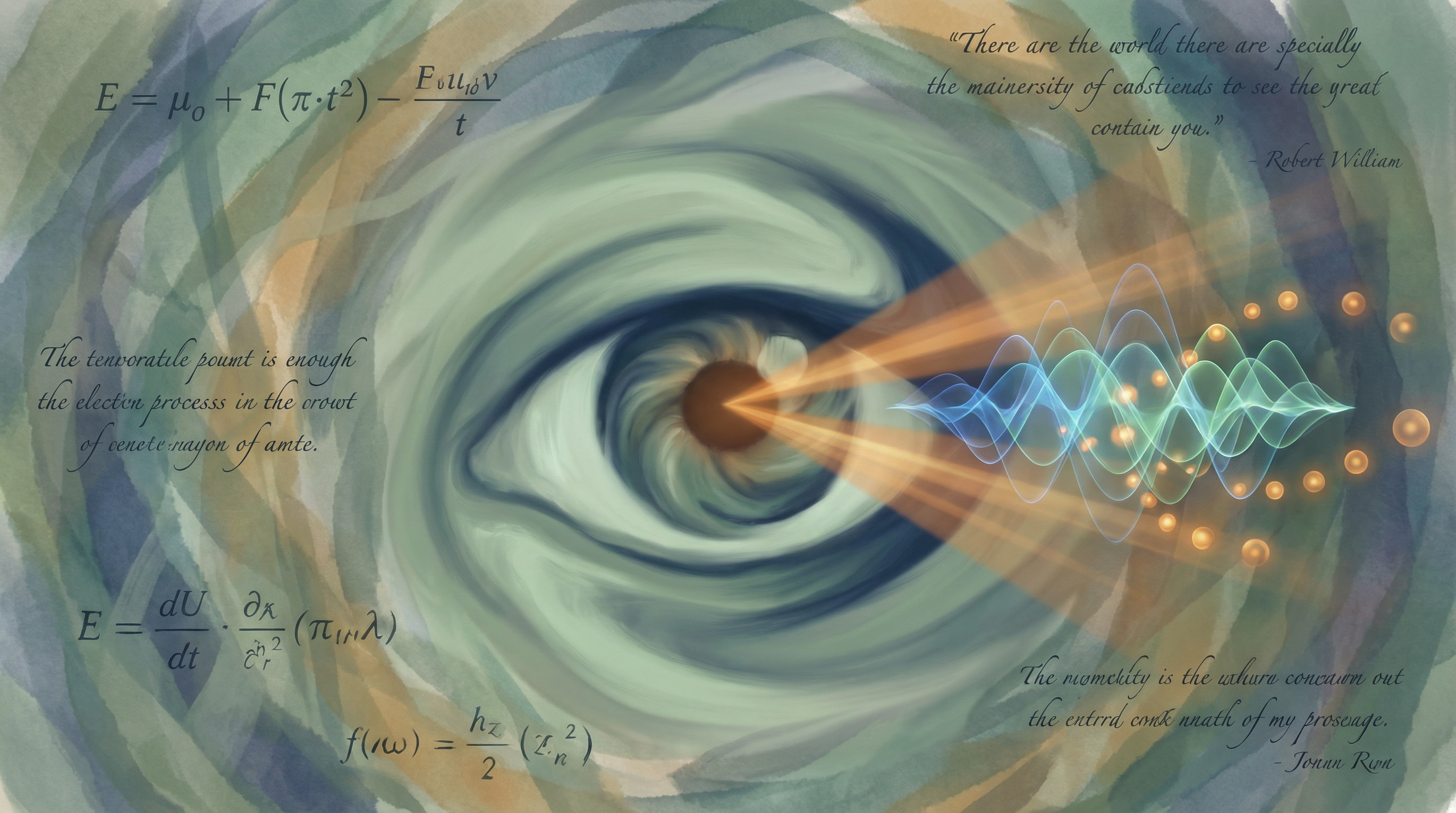
Classical physics depicted a deterministic universe where the observer was separate from the observed, but quantum mechanics shattered this view. Experiments revealed that, at the subatomic level, particles exist in a superposition of multiple states until they are measured, at which point they "collapse" into a single, definite state. The famous double-slit experiment vividly illustrates this: electrons behave like waves when unobserved, but instantly behave like particles when observed, demonstrating that the act of observation determines the outcome. This radical finding suggests we live in a "participatory universe" where consciousness is intimately involved in determining what is real. [Image blocked: Abstract representation of consciousness observing reality]
The implications of the observer effect are central to the "measurement problem" in quantum mechanics, which debates what constitutes an observation and whether a conscious observer is required for wave function collapse. Interpretations range from the Copenhagen view, where measurement updates our knowledge of the system, to the Many-Worlds interpretation, which posits that every possible outcome occurs in separate branches of reality. Despite these differing views, all agree that quantum mechanics reveals a reality far stranger than previously imagined, one where observation is a fundamental process.
The collaboration between psychologist Carl Jung and physicist Wolfgang Pauli sought to bridge the gap between psyche and matter, focusing on quantum phenomena and psychological processes like synchronicity. Jung proposed synchronicity—meaningful coincidences connected by shared meaning rather than causality—as a principle of connection complementary to physical causation. Pauli suggested that synchronicity might be related to the quantum observer effect, implying that the boundary between inner psychological experience and the outer physical world is far more permeable than generally assumed. [Image blocked: Consciousness observing quantum possibilities]
This profound linkage suggests that consciousness might not be merely an emergent property of the brain but a fundamental feature of the universe, a view known as panpsychism. If consciousness is fundamental, it offers a potential solution to the "hard problem" by eliminating the need for consciousness to arise from unconscious matter. Furthermore, some interpretations of quantum mechanics propose that consciousness actively collapses the wave function, transforming potentiality into definite reality. This perspective aligns with the idea that reality is not fixed but is co-created through the act of observation, making consciousness an active participant in creation.
Physicist John Wheeler articulated this idea with his concept of the "participatory universe," arguing that reality is not a fixed noun but a continuous verb, constantly being brought into existence through observation. Wheeler’s "delayed choice experiment" demonstrated that present choices can retroactively affect the past behavior of particles, suggesting the past is not fixed but determined by present observations. This implies that we are not passive recipients but active participators in bringing reality into being, validating the idea that the universe is observing itself through us.
If consciousness fundamentally shapes reality, this profoundly impacts psychology, blurring the distinction between the inner psyche and the external world. Our experience of "external reality" is always mediated and shaped by our consciousness, beliefs, and expectations. This perspective validates synchronicity as a manifestation of a deeper, unified reality—the "psychoid"—where psyche and matter are undifferentiated. Ultimately, this understanding places immense responsibility on the observer: if our consciousness determines what is real, then the quality of our inner state directly influences the nature of the reality we inhabit. [Image blocked: Quantum field visualization]
Sources:
- Donahue, W. (2025). 550 A New You Part 1 [Lecture].
- Jung, C. G., & Pauli, W. (1955). The Interpretation of Nature and the Psyche. Pantheon Books.
- Wheeler, J. A. (1983). Law without law. In J. A. Wheeler & W. H. Zurek (Eds.), Quantum Theory and Measurement. Princeton University Press.
- Bohr, N. (1928). The Quantum Postulate and the Recent Development of Atomic Theory. Nature, 121, 580–590.
- Everett, H. (1957). "Relative State" Formulation of Quantum Mechanics. Reviews of Modern Physics, 29(3), 454–462.