
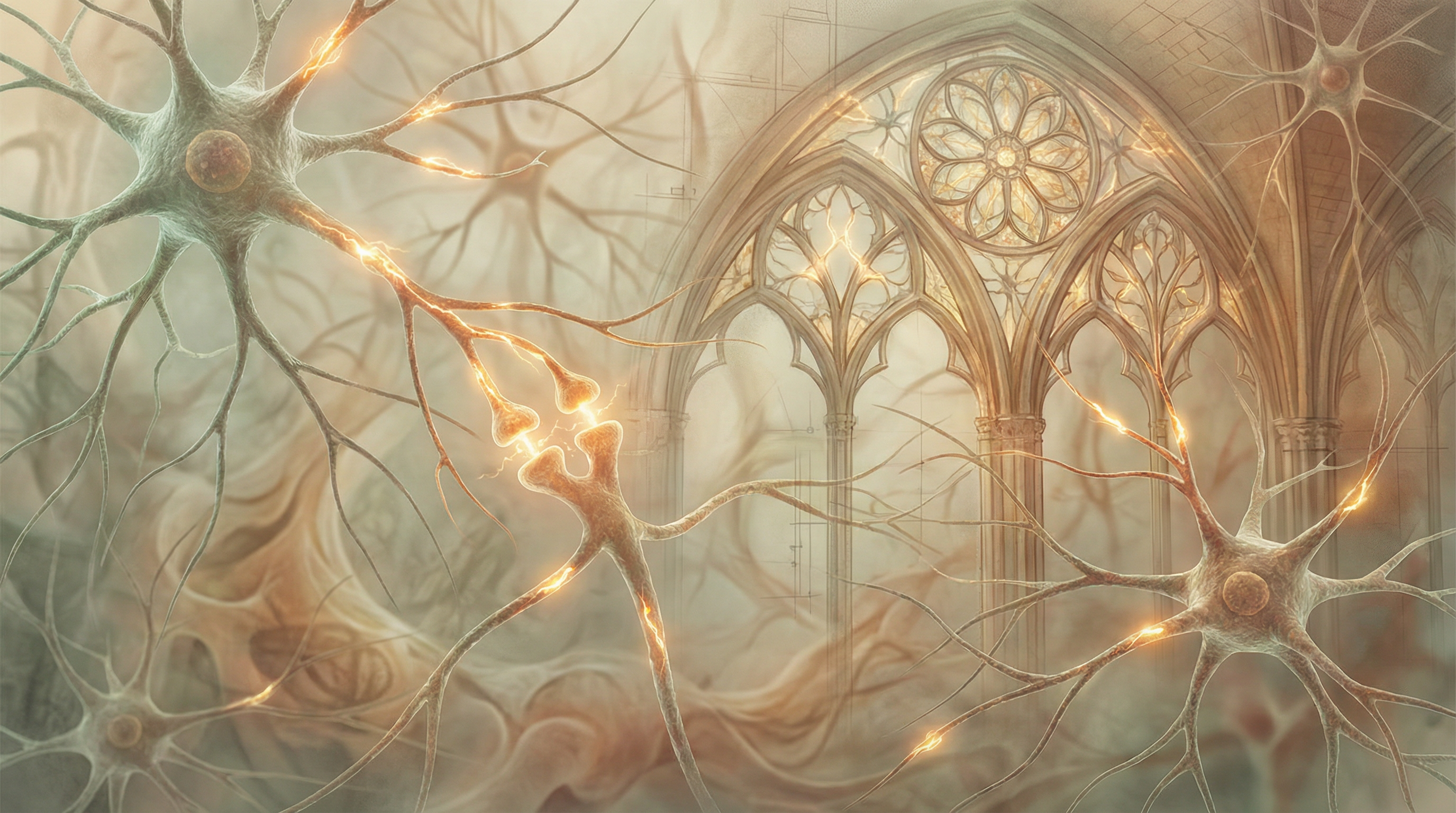
The Chemical Cathedral - Understanding the Brain's Sacred Architecture
1. Donahue, William. "550 A New You Part 1." Lecture. *Hidden Meanings*, 2011. [https://youtu.be/CNWPA9fiEo4](https://youtu.be/CNWPA9fiEo4)
The human brain is a chemical cathedral, an extraordinary biological architecture where consciousness emerges from the interplay of eighty-six billion neurons and a vast array of neurotransmitters. The central challenge, often termed the "hard problem," lies in understanding how this complex chemistry gives rise to the subjective richness of inner life. Rather than diminishing the mystery, this neuroscientific view, championed by thinkers like William Donahue, offers a radical gateway to comprehending the very structure of the psyche. It grounds the transcendent qualities of consciousness in the biological substrate of the nervous system, echoing Carl Jung's assertion that the psyche, though profound, is fundamentally rooted in biology.
[Image blocked: Neural networks forming cathedral-like patterns]
The architecture of awareness is built upon a network of staggering complexity, featuring more synaptic connections than stars in the Milky Way. Information flows through this neural web via electrical activity, modulated by a symphony of neurochemicals like dopamine, serotonin, and GABA. Every thought, emotion, and memory is encoded in these intricate patterns, meaning that the scent of rain or the joy of a memory are, at their core, complex chemical and electrical events playing out across the cortex. While this mechanistic description accurately details the process, it frequently encounters the paradox of "qualia"—the subjective feel of experience that seems to resist purely physical explanation.
Modern neuroscience reveals that the unified "self" is an emergent property arising from the coordinated activity of multiple brain systems, each operating through specific neurochemical pathways. The prefrontal cortex manages executive function, the limbic system handles emotion, and the default mode network constructs our continuous identity. Dopamine drives motivation, serotonin modulates mood, and the balance of glutamate and GABA creates the rhythmic activity underlying consciousness. This understanding confirms that we are, literally, chemical and electrical beings, where our sense of self is constructed moment by moment through the coordinated release of neurotransmitters.
[Image blocked: Neurons with glowing synaptic connections]
Carl Jung intuited this deep connection between mind and body, proposing "psychophysical parallelism"—the idea that psychological events have corresponding physiological correlates. He saw the psyche not as a disembodied entity but as an emergent property of the living organism, encompassing both conscious and unconscious elements. Modern research on implicit memory and emotional processing supports Jung’s framework, suggesting that the "collective unconscious" may correspond to ancient, shared brain structures. The neurological substrates of fear (amygdala) and basic drives (hypothalamus) provide the biological foundation for what Jung termed instincts and archetypes.
Understanding consciousness as a neurochemical phenomenon challenges Cartesian dualism, the persistent separation of mind and matter. If the mind is what the brain does, then the illusion of a separate observer dissolves, leaving only an extraordinarily complex, self-organizing system. This perspective aligns with Jung’s later concept of the unus mundus, or "one world," where psyche and matter are two aspects of a single underlying reality. Recognizing that our thoughts are patterns of neural activity allows the illusion of separation to fade, affirming that the observer is not separate from the observed, and consciousness is inseparable from the brain that generates it.
This biological foundation does not reduce psychological growth but enhances our appreciation for transformation through neuroplasticity. The brain is a dynamic system capable of reorganizing itself in response to experience, meaning conscious effort, therapy, and practices like meditation can literally rewire neural architecture. Jung’s concept of the "transcendent function" has neurological correlates in the integration of different brain networks. By consciously reshaping our emotional and cognitive patterns, we modify the physical structure of our brains; thus, the self is not fixed but fluid, continuously created through intentional choices.
The insight that consciousness arises from the coordinated activity of billions of neurons need not lead to disenchantment; rather, it inspires profound wonder. The chemical cathedral is sacred because it is the site where matter becomes aware of itself, generating subjective experience from objective processes. The neurotransmitters cascading across synapses are the very substance of thought and feeling, and the electrical impulses are the medium through which experiences of love, beauty, and truth are realized. The challenge lies in embracing this paradox: recognizing the material basis of consciousness while honoring its qualitative, irreducible nature.
[Image blocked: Artistic brain cross-section showing electrical activity]
Sources: Damasio, A. (1999). The Feeling of What Happens: Body and Emotion in the Making of Consciousness. Harcourt Brace. Harris, S. (2014). Waking Up: A Guide to Spirituality Without Religion. Simon & Schuster. Jung, C. G. (1969). Mysterium Coniunctionis: An Inquiry into the Separation and Synthesis of Psychic Opposites in Alchemy. Princeton University Press. Jung, C. G. (1989). The Structure and Dynamics of the Psyche. Princeton University Press. Nagel, T. (1974). What Is It Like to Be a Bat? The Philosophical Review, 83(4), 435–450.